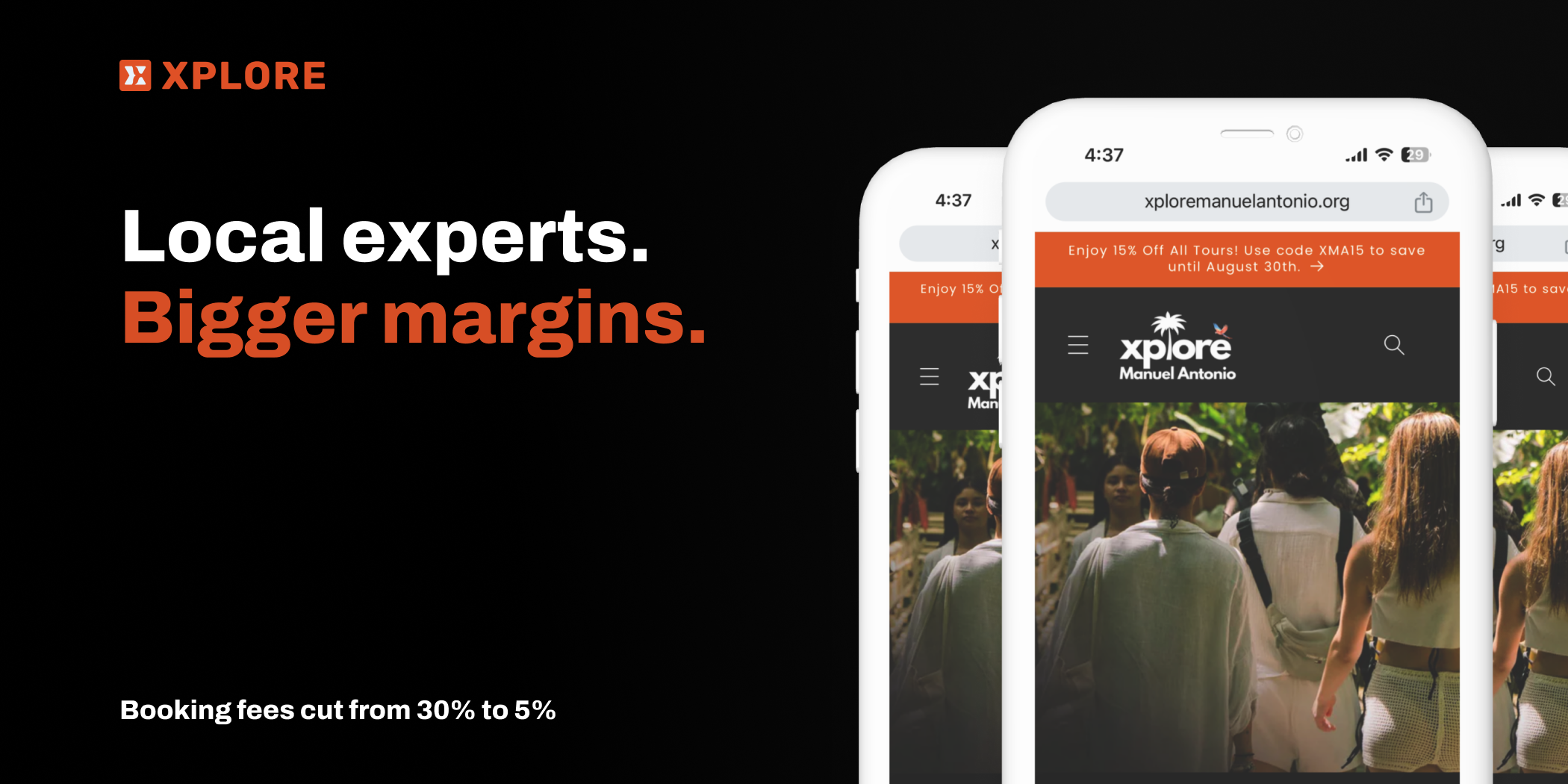
Manuel Antonio's first tour-booking platform — giving travelers the local support the major OTAs can't, and cutting fees from 30% to 5%.
Local tours, global storefront — and 30% gone with every sale
XMA's founder identified there was a lack of local expert support for travelers who booked a tour through a major OTA — GetYourGuide, Viator — and that no local platform existed to provide it either.
With no platform of its own, XMA — like every other local guide and agency in Manuel Antonio — depended entirely on the major OTAs to sell online, paying a 30% fee on every booking.
Searches "tours in Manuel Antonio"
No dedicated local platform exists
Poorly designed, zero trust signals
Books through GetYourGuide / Viator
Searches "tours in Manuel Antonio"
No dedicated local platform exists
Poorly designed, zero trust signals
Books through GetYourGuide / Viator
Two symptoms. One cause.
Travelers (my users) struggled with a lack of local platforms online — so they overpaid on the major OTAs, which sell reach, not local knowledge or support when something goes wrong.
The business lost 30% of every sale — its self-made website couldn't handle bookings or take payments. That only reinforced its dependency on the OTAs.
Live today, final tomorrow
The business had a hard requirement: build a functional website, live and converting, while research for the final design was still underway.
"How do I ship a converting site now — while I run the research for the final design?"
Evidence first — assumptions never.
Diagnose the drop-off.
I audited real sessions on the existing site to see exactly what was pushing travelers away.
Ship the pilot.
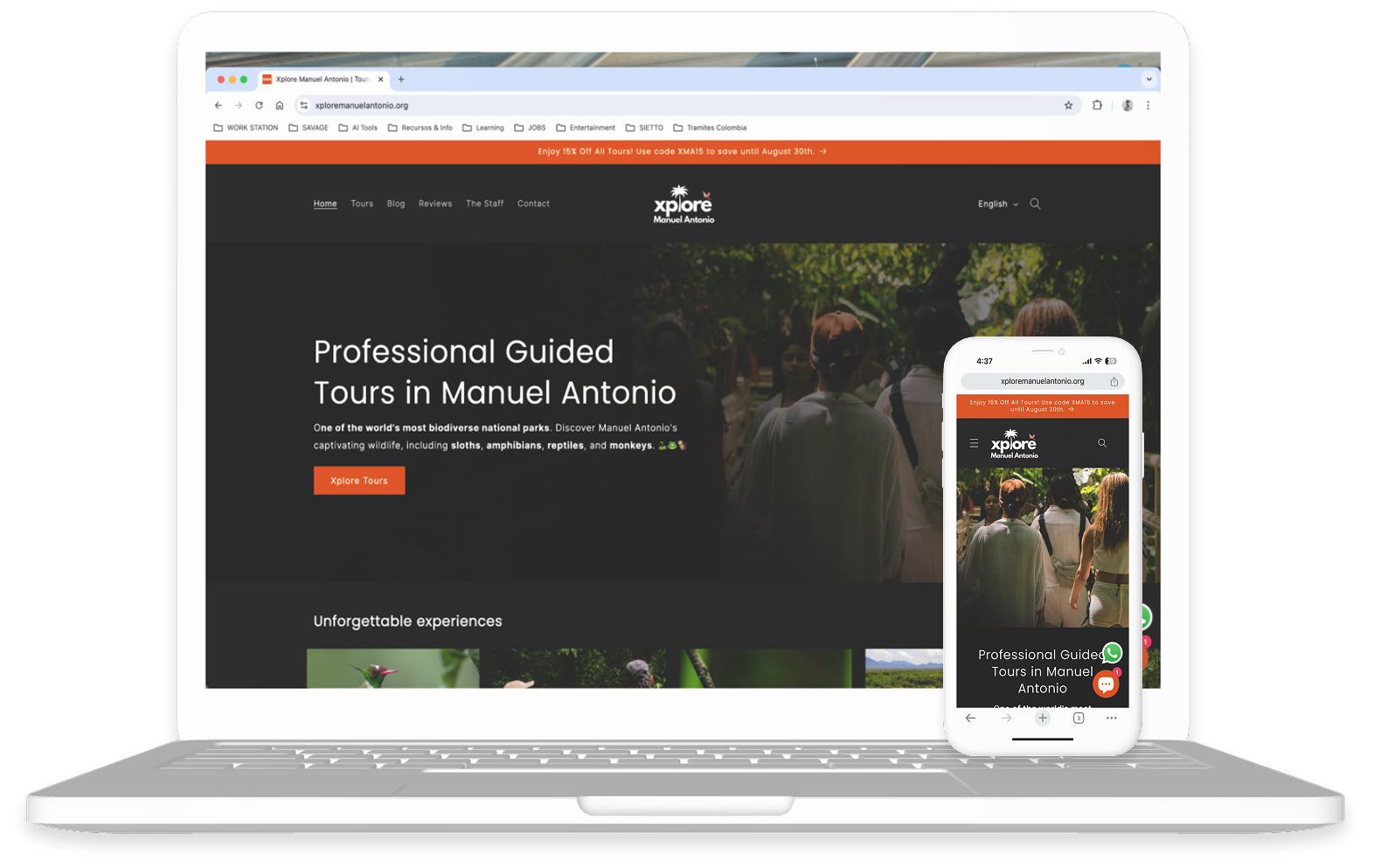
The findings from the diagnose let me launch a functional, converting site fast — meeting the business's requirement and proving the concept early.
Find the real need.
With the site live and converting, I ran a design-thinking loop — empathize, define, ideate — to lay the groundwork for a future final design based on evidence, not guesswork.
Ten sessions told me what a survey never would
I ran a Hotjar watch party across ten high-relevance session recordings, chosen to pinpoint what was quietly killing functionality and conversion on the client's self-made site.
Excessive text, poor use of space, almost no imagery
Rage scrolling, then leaving without finding what they came for.
Redesign the UI around e-commerce principles
Trade dense text for appealing imagery, clean hierarchy and CTA sections.
Malfunctioning booking CTAs
The one action the site existed for, failing.
Integrate a booking system
Make the core action work.
A broken reviews widget
Removed the proof travelers rely on.
Dedicated Reviews page
Restores the proof travelers rely on.
Go live, prove the concept
The goal was narrow and deliberate — not to ship the final product, but to prove a direct channel could work at all. In its first month, the pilot delivered measurable proof:
The market's average conversion rate sits around 3% — the pilot beat it in its first month.
Every booking now nets the platform six times more than it did through the OTAs.
They didn't want a better tour. They wanted a local friend.
I interviewed 4 frequent travelers and tour-takers to understand their needs, frustrations, and — above all — what they actually wanted from a local platform: not just a way to book a tour, but the kind of trustworthy, on-the-ground guidance you'd get from a friend who already lives there.
From there, I synthesized that research into empathy maps, cross-referencing interests against pain points until five clear patterns emerged — the patterns that shaped the user personas I'd use to ideate solutions.
"My time is limited, I plan everything jam-packed in advance."
- Find consistent review trends and enough insider information.
- Access human support via phone call or WhatsApp for quick issue resolution.
"I'm very independent — as a last minute person, if I can do it myself, it'll be faster."
- Book tours autonomously using AI responses for quick resolutions.
- Receive push notifications for tour updates, recommendations, and cancellations.
- Access real-time human support only when it's completely necessary.
Five questions became five features
I reframed each pain point as a How Might We, then mapped the answers to features:
Adapt the process — don't abandon it
The real lesson here wasn't about method — it was about priorities. A textbook design process rarely survives a client's reality: XMA needed a live, converting pilot site, and the business couldn't wait for a full research cycle to finish.